


This Advent, we gather around the familiar story of the Birth of Jesus Christ and cherish Him, just as the shepherds and wise men did. Let us adore Him, as they did. In these four devotionals, we will look in more detail at the gifts Jesus was brought as an infant, and the deeper meanings behind them, as a way to better understand the person we seek to adore: the one whose Word lies in the pages of the Bible, the one who breathed life into each one of us, and the one whose fragile form lay in the arms of His mother Mary all those Christmasses ago.
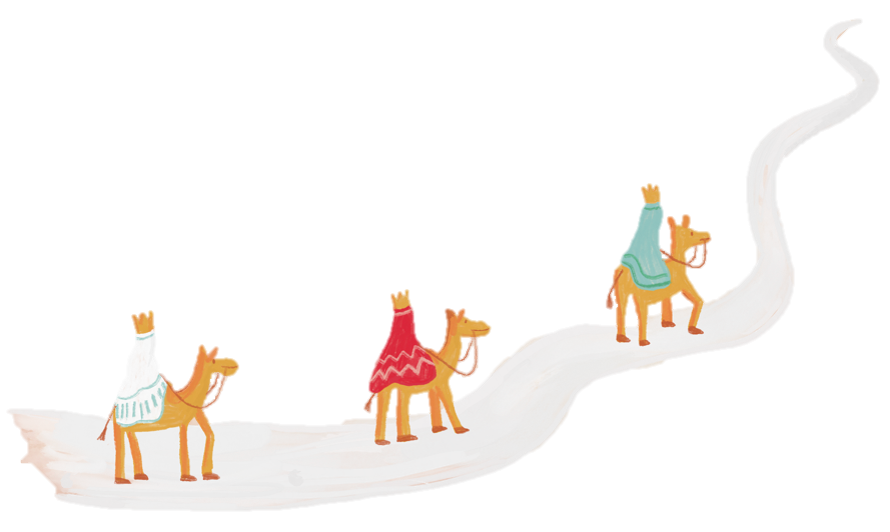
The familiar story of Jesus’ birth begins in Bethlehem, in Judea. However, some months later, as a young child, Jesus is greeted by perhaps the most noble guests to ever enter the home of Mary and Joseph. Despite their noble background, they bow down before Jesus. These wise men, or magi, who have travelled from Persia (Iran) are guided by God in order to present three traditional gifts to the young child. But why do they come and bow down? And what does this passage teach us about the person of Jesus?
‘On coming to the house, they saw the child with his mother Mary, and they bowed down and worshipped him. Then they opened their treasures and presented him with gifts of gold, frankincense and myrrh.’ – Matthew 2:11

Gold is the first gift to be mentioned in Matthew’s Gospel. As precious a metal then as it is today, gold has been a symbol of kings throughout history, and herein lies the meaning behind this lavish gift. This little baby wasn’t born into human wealth, but into the line of David, and this lineage helps us to understand why the magi bow down before Him.
‘To you in David’s town this day, is born of David’s line,
a Saviour who is Christ the Lord, and this shall be the sign’,
As in the familiar carol, Once in Royal David’s City, we are reminded of the importance of Jesus’ heritage through this gift of gold. If you flick back a chapter, Matthew deliberately places the genealogy of Jesus at the beginning of the Gospel narrative, so that his readers might understand the bloodline that Jesus is born into, and see that He is the Messiah, who is to come from the line of David. Thus, when the wise men come and present a gift of gold to the young Jesus, we understand that they have supernaturally grasped that He is the long-awaited King. It will take some time however before we see that Jesus is not the sort of king to overthrow earthly rulers, but instead to take His throne in heaven.
Gold is oft-used as a material to produce crowns from, but Jesus does not rule wearing a gold crown, though He describes the Kingdom of God as near many times in His ministry (e.g. Mark 1:15). Instead, in passages such as Luke 19:28-40, we see Jesus humbled. He first rides into Jerusalem, the city David called the centre of His kingdom, on a donkey, with certainly no crown around His head. Fast forward a few chapters and Jesus is humiliated by taking on a crown, not of gold, but of thorns as He is mocked and insulted at the cross.
So where then is His kingship? Well, written in jest on the cross He is nailed to is ‘Hail, King of the Jews’ (Mark 15:18). Even those who mocked Him could understand that Jesus claimed to fulfil the Old Testament prophecies, of a King and Messiah.
Crucially, they lacked the supernatural insight that God granted the wise men those thirty years earlier, and later to the Apostles, that Jesus’ Kingdom would be elsewhere. His kingship was defined by a servant nature, with a humble heart which subverted expectations. There was no gold crown or chariot.
So, as we lift our eyes to heaven, and consider that the gold gifted to Jesus is a picture of the throne that Jesus now sits on, we can take a moment to adore Jesus as the King of kings and the Lord of lords, the one who is seated at the right hand of the Father.
Is Jesus king of your life today?
Lord, we pray that You will reveal to us Your nature this Advent season. Help us to grasp the glory, power and majesty of Your throne, and help us to bow down before You as the one true ruler and Lord of our lives. As we hear the familiar story of wise men presenting gifts to You as an incarnate baby, may You grant us eyes to see You for who You are.
Amen.
Jesus the King was written by Thomas McBride
A common question for CUs to discuss with seeking students on campus is, ‘If you could ask God one question, what would it be?’. But perhaps an equally valid, though less common, question might be ‘If you met God, what would you do?’. The Magi are certainly clear on their answer as they announce to King Herod: ‘We have come to worship Him’. Their sure intent as they seek baby Jesus, is not just to catch a glimpse of Him from afar, but to worship Him.
These men show great understanding and faith, as they humble themselves to bow down to a child. It should be a humorous picture: wise men, learned men, respected men, bowing before an infant, and yet it seems there’s no place for laughter, except maybe out of overflowing joy. But their worship isn’t contained only to their posture, it is found also in their presents, as they offer Jesus the gift of Frankincense.
Though we may be hoping to receive a nice bottle of fragrance this Christmas, incense was much more than perfume to the Israelites in the Old Testament. It was a central part of their regular worship; a pleasing aroma offered to God as He met with His people.
And yet here we see God meeting with His people in a way many of them could never have imagined, choosing to become like us, being born of a woman, taking on human flesh. Jesus Christ, Lord of all creation, the one who made you and me, who sustains the entire universe, comes to be with us, and is born a baby – 'fullness of God in helpless babe'.
How astonishing that God Himself should stoop to walk amongst humankind, to live a life of service, and die the death of a criminal.
So just as Christ loved us and gave Himself up for us as a fragrant offering to God (Ephesians 5:2), would we offer our lives, our worship and our prayers, as a pleasing aroma to the Lord?
And as we do so we remember that our hope lies in an occupied manger and an empty tomb. Our hope is in Jesus Christ, the only one who could make us right with God, as both God Himself and man himself, Emmanuel…
God with us.
Lord, we pray that You will remind us this advent season just how much of a blessing it is to be able to call on Your name in prayer. Thank you that You are Emmanuel, God with us. No longer do we walk in darkness, but we have seen something of the glory of the Father through You, Jesus. Help us to be as excited to meet You in prayer as the Magi were to meet you face to face as a young child.
Amen
Jesus the Divine was written by Laura Chimes
Myrrh, the gift from the Magi that no one can ever spell… or maybe that’s just me? It’s a strange gift for a baby. Then again, all of their gifts were unusual. These weren’t toys for Jesus to play with, or practical things to help Mary and Joseph – as we’ve seen over the past few weeks, the gifts of the Magi were deeply symbolic. Gold pointed to His kingship, Frankincense spoke of His divinity, and now, Myrrh, a gift with a meaning that feels almost jarring.
In Jesus’ time, myrrh was commonly used for embalming the dead. Imagine bringing a gift with such heavy symbolism to celebrate a birth, it’s like showing up to a baby shower with a funeral wreath. Yet, in God’s upside-down kingdom, this prophetic gift pointed to something beautiful, something great: Jesus’ death.
When the Magi laid myrrh before the newborn King, they couldn’t have known that years later, myrrh would appear in Jesus’ life again – offered to Him on the cross, mixed with wine (Mark 15:23), and later brought by Nicodemus to anoint His body after His death (John 19:39-40). No one knew… except Jesus. For the Son of Man came to seek and save the lost (Luke 19:10), and He knew that His life and ministry were always leading to the cross. For Jesus, even His birth carried the shadow of the cross, because He knew this act of sacrifice was what we most desperately needed.
The classic Christmas carol Hark! the Herald Angels Sing has a line in it that always takes my breath away:
‘Mild He lays His glory by, born that man no more may die…’
As I sing this carol, year on year, my mind is cast forward to Easter, when we celebrate the culmination of everything that Jesus came to earth to accomplish. Because unlike any other birth, Jesus’ arrival on earth is worth celebrating even more joyfully because of His death. Without His death, we wouldn’t have forgiveness for our sins, communion with God the Father, and the hope of eternal life. Without His death, we wouldn’t know what it is to have a Saviour who suffers with us, who understands the pain of this world or know that, ultimately, He has redeemed it all.
Lord, how unlike any other king you are – coming to earth, not to wield your power, or assert your throne, but to die, to take our place. As we comprehend this great mystery again this Christmas, may we adore you even more deeply, and may our adoration become the fuel that drives us in 2026, to display and declare the power and goodness of your sacrifice, to a world that desperately needs it.
Amen
Jesus the ultimate sacrifice was written by Kate Harvey

And there were shepherds living out in the fields nearby, keeping watch over their flocks at night. An angel of the Lord appeared to them, and the glory of the Lord shone around them, and they were terrified. But the angel said to them, ‘Do not be afraid. I bring you good news that will cause great joy for all the people. Today in the town of David a Saviour has been born to you; he is the Messiah, the Lord. This will be a sign to you: you will find a baby wrapped in cloths and lying in a manger.’
So, they hurried off and found Mary and Joseph, and the baby, who was lying in the manger. When they had seen him, they spread the word concerning what had been told them about this child, and all who heard it were amazed at what the shepherds said to them.
– Luke 2:8-18
Winding the clock back to Jesus’ birth, in Luke’s Gospel we read of a very different group of visitors who come to pay their respects to the incarnate Jesus. The shepherds couldn’t be more different from the Magi – Jewish, with likely some knowledge of the promised Messiah and with no earthly riches to their name. For them, the angel’s news must have caused great excitement and promise.
Once they had overcome their initial fear having witnessed a heavenly host of angels before them, the idea that the promised Messiah had come would have led them to think that Israel might be restored and perhaps even freed from oppressive empires such as the Romans. In other words, their saviour had come. Although they wouldn’t understand what that meant, they knew this was an incredibly special moment, and travelled to visit Jesus.
Had the shepherds gifted anything to the baby Jesus when they visited, it would most likely have been a lamb, their most prized possession. Christina Rosetti puts it beautifully in the well-known carol,
In the Bleak Midwinter:
What can I give Him,
Poor as I am?
If I were a shepherd
I would bring a lamb,
But even if the shepherds did not present a gift, the story of their visit carries great weight. A visit from lowly shepherds is not only a contrast to the Magi, but a beautiful picture of role reversal too. Lowly and humble at the birth, this is who Jesus wanted as a witness – the first reflection of the kind of saviour He would be. The shepherds are a picture of care and humility as they bow down before Jesus, a sign that He would become a shepherd, not of sheep, but of people.
This kind of pastoral imagery is common in the New Testament, like in John 10:11-18, where Jesus describes Himself as both sheep and a shepherd. Therefore, a visit by shepherds feels most fitting at his birth, more so than a visit from any early king or great leader.
The imagery doesn’t end there. Jesus is not only the giver of life, the good shepherd, but He is also the gift! He is the proverbial lamb who takes away the sin of the world through His sacrifice, something we looked at last week as we dwelt on the gift of myrrh from the Magi. Beautifully, we don’t just have a saviour who cares for us as a good shepherd, a God on high, but one who came as a meek and mild lamb to die for the sins of the world (Hebrews 4:15). Both fully God and fully man, He came into this world to understand our hopes and fears; to be tested and all the while remain free from sin.
This is the joy of Christmas. That Christ came down to earth to live as we live, to be as humble as the shepherds who visited Him that first Christmas, and yet to go on to be the lamb who died in our place that we might have the gift of salvation.
So, this Christmas, two thousand years on, how shall we respond to the gift of this baby? Now returned to heaven and sitting at the right hand of God, we cannot bring Him a lamb. How then shall we respond? We can have a relationship with Him, the giver and the gift. Nothing could be better this Christmas:
Yet what I can I give Him,
Give my heart.

Lord,
Thank you that You came down to earth from heaven to live as we live, to experience our hopes and fears, and to be our good shepherd who understands our every need. Thank you too that You are not just our provider, the one who gives great gifts, but You are the gift itself, the fullness of love and mercy as You took the role of the lamb who was slain. Please draw near to us this Christmas, help us know You ever more deeply and appreciate all that we have in you.
We praise You and thank You with our whole heart, mind, soul and strength.
Amen
Jesus the good shepherd was written by Thomas McBride